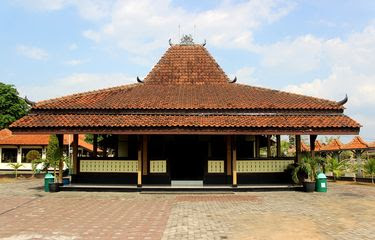
The Joglo house is a traditional Indonesian architectural style originating from the Javanese people of Central Java. Joglo houses are known for their large and spacious main halls, or "ruang utama," which are supported by tall, carved wooden pillars. The style is characterized by its intricate wooden carvings, soaring rooflines, and use of natural materials such as teak wood and thatched roofs.


Historical joglo type articles

Old Joglo house style with sacred carvings


The origins of the Joglo house can be traced back to the Mataram Kingdom of Central Java, which flourished between the 16th and 18th centuries. During this period, Javanese nobles and royalty built large, elaborate homes, many of which were designed in the Joglo style. These homes reflected the prosperity and cultural sophistication of the kingdom, and were designed to showcase the wealth and status of their owners.


Joglo houses were not just a symbol of prestige and wealth, but also played an important role in Javanese culture and daily life. The large main hall was used for communal gatherings and ceremonies, such as weddings, religious celebrations, and other important events. The intricate carvings and decorations on the columns and rooflines were also believed to hold spiritual significance, imbuing the house with a sense of protection and good fortune.


One of the most distinctive features of the Joglo house is its large, open-air central hall. This central space is often surrounded by smaller rooms and balconies, creating a sense of flow and connection between the interior and exterior of the home. The roof is supported by tall wooden pillars, which are often carved with intricate designs and patterns.


Joglo houses were traditionally constructed using locally-sourced materials, such as teak wood for the columns and roof, and bamboo for the walls and flooring. This use of natural materials helped to create a sense of connection to the surrounding environment and to local building traditions. The roofs were also typically thatched with local grasses, which provided insulation and helped to keep the interior cool in the tropical climate.


Despite its popularity, the Joglo style faced challenges during the colonial period, when many traditional homes were destroyed or modified to conform to Western architectural styles. However, in the post-independence era, there was a resurgence of interest in traditional Javanese architecture, and many Joglo houses were restored or rebuilt.


Today, the Joglo house continues to be an important part of Javanese cultural heritage, with many examples still standing in villages and cities across Java. The style is also being revived in contemporary architecture, with many modern homes incorporating elements of the Joglo design in their construction.


In addition to its cultural significance, the Joglo house is also recognized for its environmental sustainability. The use of natural materials and traditional building techniques helps to reduce energy consumption and minimize the environmental impact of the building. This makes the Joglo house a model for sustainable architecture and a symbol of the enduring importance of traditional building practices.


In recent years, there has been a growing interest in preserving and promoting the Joglo style among tourists and visitors to Indonesia. Many Joglo houses have been converted into museums, hotels, and cultural centers, allowing visitors to experience the beauty and cultural significance of the Joglo style.


In conclusion, the Joglo house is an important part of Javanese cultural heritage, reflecting the richness of the island's architectural traditions and the ingenuity of its people. Whether viewed as a symbol of prestige and wealth or a model for sustainable architecture, the Joglo house remains an enduring legacy of Indonesian culture and a testament to the importance of preserving traditional building practices

ARIF BLOG 9:13 AM
Read more ...

The Indonesian keris is a traditional dagger originating from the Indonesian archipelago. It has a long and rich history, with evidence of its use dating back to the 9th century. The keris was not only used as a weapon but also as a symbol of prestige, power, and cultural identity among Indonesian communities. The blade's unique wavy shape and intricate hilt decorations were believed to hold magical powers and were often passed down from generation to generation.


The origin of the keris remains a subject of debate among scholars and enthusiasts, with some suggesting that the weapon originated in India and spread to Southeast Asia through trade and migration. Others argue that the keris is indigenous to the Indonesian archipelago, with the earliest examples having evolved from simple iron daggers used by early Austronesian communities.


Regardless of its origin, the keris played an important role in Indonesian history and culture, appearing in many of the island nation's myths, legends, and historical accounts. It was often used as a symbol of prestige and power, with rulers and nobles commissioning elaborate and ornate examples to showcase their wealth and status.


The art of keris-making also developed into a highly specialized skill, with many regions of Indonesia producing their own distinct styles. Some of the most famous keris-making centers include Central Java, Bali, Sumatra, and West Java, each with their own unique techniques, materials, and designs.

One of the most distinctive features of the Indonesian keris is its wavy blade, which is thought to symbolize the ocean and the life-giving force of water. The blade's unique shape was also believed to hold magical powers, making the keris a powerful talisman as well as a weapon. The hilt of the keris was also often decorated with intricate carvings, inlaid with precious materials, or wrapped in precious metals, further enhancing its value and prestige.


The keris was not only used as a weapon but also as an important part of Indonesian dance, art, and literature. It appeared in traditional dances such as the Javanese Kethuk-Kethuk and the Balinese Barong, where it was used to symbolize power, grace, and protection. It was also depicted in traditional Indonesian paintings and sculptures, further cementing its place in the country's cultural heritage.


In addition to its cultural significance, the Indonesian keris also played a role in the country's political and military history. It was often carried into battle by Indonesian warriors and was used to settle disputes and defend the kingdom. The keris was also considered a powerful talisman, providing its bearer with protection, strength, and the ability to overcome adversity.


Despite its rich history and cultural significance, the keris faced challenges during the colonial period, when the Dutch attempted to ban the weapon in order to exert control over the Indonesian population. However, the keris continued to be passed down from generation to generation, preserving the rich cultural heritage and traditions of the Indonesian people.


Today, the Indonesian keris remains an important part of the country's cultural heritage, with many enthusiasts and collectors around the world seeking out authentic examples. It is also still produced by traditional keris-makers, who continue to carry on the skills and traditions of their forebears.


In conclusion, the Indonesian keris is a remarkable weapon and cultural artifact, embodying the rich history, traditions, and beliefs of the Indonesian people. Whether used as a weapon, a symbol of prestige, or a cultural artifact, the keris remains an enduring symbol of Indonesian culture, reflecting the country's rich heritage and enduring traditions

ARIF BLOG 9:04 AM
Read more ...


The sheath is one part of the keris which has the main function of being a container for the keris blades. 

Apart from that, in the current social lifeof Javanese society, warangka can also often show the social status of its users, because it is from this sheath that its shape and beauty can be directly seen.


In Javanese custom, the keris sheath can be categorized into two types, namely the Ladrang and Gayaman keris warangka. 


In general, the sheath of a keris is made of wood or ivory, covered with metal ornaments such as brass or gold. This sleeve-shaped bandage made of metal is commonly referred to as pendok.


The Ladrang keris sheath has a more complicated shape than the Gayaman keris. The sheath of the Ladrang keris consists of several parts called Acup, Cheek, Beard, Crew, Godongan, Ada-ada, Pindakan, Axle (antupan) and Pendok. Javanese keris, according to the shape of the pendok there are three kinds, viz


1.Pendok bunton is in the form of a flat sleeve without a slit on the side

2.Pendok cantaloupe (blengah) is split lengthwise to one end so that the axle can be seen

3.Pendok mask with a split only in the middle.


The Ladrang keris sheath is generally worn by Javanese people when participating in official palace ceremonies and Javanese traditional marriages. 


The use of the Ladrang keris is intended as a tribute to the king and the guests at the ceremony. 

The procedure for its use is to tuck the axle of the keris into the fold of the belt (stagen) at the back of the waist (including as a consideration for the king's safety)

ARIF BLOG 5:25 PM
Read more ...
this time I will give you posting about household products charming handicraft products from raw materials very simple but faforit when they process into a masterpiece.

history
Hyacinth or water hyacinth (Latin: Eichhornia crassipes) is one type of aquatic plants float. Besides known as water hyacinth, in several regions in Indonesia, the water hyacinth has another name, such as in the area of ​​Palembang known Kelipuk, in Lampung known Ringgak, in Dayak known Ilung-Ilung, in Manado known Tumpe. 
Water hyacinth was first discovered accidentally by a scientist named Carl Friedrich Philipp von Martius, a botanist German in 1824 while on an expedition in the Amazon River Brazil. [2] hyacinth has a growth rate high enough to plant this is considered as weeds that can damage the aquatic environment. Hyacinth easily spread through the water supply to other water bodies.

Water hyacinth floating in the water of life and sometimes rooted in the soil. It was about 0.4 to 0.8 meters. Not having a rod. The leaves single oval. Tapered tip and base, base of the petiole bubble. Surface slippery and green leaves. The flowers including compound interest, shaped grains, tubular petals. The seeds are round and black. The fruit boxes and bears three green


handycrafts
This sofa is an excellent craft oaleh hands that have tenacity in processing an item is useless becomes a work that is very beautiful and can be used as seating. may previously only a tnaman who only make a dirty pool. but after this water hyacinth plants in the dry and in knitting into a chair be seem beautiful, to sit and even to be sold as handicrafts are very intersting.

size
for this model of sofa set mmpunyai minimal size. not only made for chairs, sofas, but by the hands keratif this rubbish created such and processed into a work that is very encouraging.
ARIF BLOG 4:10 AM
Read more ...
this time in the post I will discuss about the antique table from the dimples that are very ancient but can be used for a very antique table after a bit polished to beautify the table. thus the table seems charming and beautiful for the eye.

history
history of dimples is itself a relic of nenenk history of our ancestors who used to pound rice or to play musaik (gejok). gejok is a blend of music that is played on a full moon by mothers in ancient times to not tdur afternoon. they get together and play instruments musaik of mortar antique teak this. in addition to playing musaik well, teak mortar has a function as a pounder at the touch of rice pounder made of wood to pound rice. because in ancient times there has been no rice mill. the ancients if you want to make the rice is pounded in a mortar and manually done by mothers. but if it is now very rare because the existing rice mills can be very quick to peel bran.

size
the size of the mortar itself variegated vary because each region has a different length and large therefore not sama.kalau every area we cover in this post is not too long to medium size.


Read : ancient oil lamp brass
 
why antique
why dimples can be called antique teak because it has a very feminine and elegant shape. with architects typical and very charming. the longer mortar bnayak teak is increasingly in demand by the search antique lovers and collectors of antiques. because of the shape of a charming and simple old forms and fiber that indicates how long the wood that is used for these dimples.

collection
for the collection of teak mortar itself is very rare and very rare, only certain people are still deliberately keep or have dimples teak is of the shape and material timber, which was old-fashioned. thus teak wood mortar is indeed very ancient. with a little polish and a bit penambahanan ornament can be used as a table very beautiful and charming to be made in the collection of antiques.
demikian informasi yang sangat penting ini yang bisa saya berikan kepada pecinta barang antik.
ARIF BLOG 3:38 AM
Read more ...
continuation of the ancient lamp this time I still want to give information about the lamp . This time the old-fashioned lamp as well . These lights are very popular in the countryside and the Kingdoms. if this lamp antique lamp in hurry because bentukny antique and charming .

lanngsung course we headed to the description of light that will be discussed . namely that only the kerosene lamp bulbs which use kerosene for the medium, and using axes , the kerosene lamp was very simple . but many find by collectors of antique lamps .

This lamp made ​​of brass and is very rarely encountered since their electricity. but still many people are very interest to use these lights for decoration in the house , so that they feel in the era of the 80s and still tasted wonderful
ARIF BLOG 11:36 PM
Read more ...
to resume my post yesterday. Yesterday several times giving out info on the history. this time I will also give a history of ancient chandelier. which in this saaat hunted by the people who like to antiques and collection. it did not escape the history and uniqueness of the lights which have high artistic value.

ok we just briefly entered into our discussion of the history of kuno.Sinar warm light and a ray of light that will illuminate the darkness of the night that can make you become more comfortable, feel calm and feel happy with an artistic blend of antique lamps, because the art contained in a lamp is presented can make you feel to be very quiet with the element of art produced.


This lamp is used by the kingdom of the era of the kingdom. only the rich people who are already using these lights. because of the very high price in the future. because it has a unique design and style of these lights. using gatungan.mempunyai lid or cap hanging above and to the side decorated with carvings. This engraving makes this lamp has an antique value.

with these lamps in pairs on the front porch and living room will look charming and made the room seem cozy teasa seemed at first royal era.
ARIF BLOG 11:23 PM
Read more ...
on this occasion posts related to the history of friends. because we know the history can be called a special hinga jogja yogyakarta very special because of the culture and kalakuan Javanese people were very calm.

Enjoy the corners of the old city of Yogyakarta at night was really exciting. This we did after going home berlebaran to Cilacap, Central Java some time ago. It was still early when the five of us up at the Bus Station in Yogyakarta. 

Thanks to the manual one passenger bus, our family finally decided to stay overnight in a simple guesthouse near the terminal's magnificent. My eldest nephew Lely wants to fill that afternoon with visiting Sultan Palace complex. While his wife, son and a nephew who is also the brother Lely prefer to spend time with the rest at the inn. 

Really disappointed our hearts when he arrived at the region Rotowijayan turned out of the palace was closed. But we could obtain information from an officer of the palace when the Ancient Horse Carriage Museum is located next to the palace it is still open to visitors. Without wasting a chance we ended up towards the museum. Horse Carriage Museum Yogyakarta Sultanate's ancient numbering tens.

This is where tourists can see directly the various types of old-fashioned horse-drawn carriage nan antique that was used by the Sultan and his descendants. Old-fashioned horse-drawn carriages are generally ordered from the Netherlands. Everything is still in good condition and well maintained. In fact, there is a train which was made in the 1700s. Each visitor to the museum entrance ticket charged Rp. 4000, -. Certainly very affordable when compared to the benefits it's enormous. There are about twenty-three old-fashioned horse-drawn carriages were stored and well maintained in Yogyakarta Rotowijayan Railway Museum. The horse-drawn carriages used to be a vehicle Sultan Yogyayakarta and relatives empire. Such as Train Kanjeng Nyai Jimad. It is said that is the pride and heritage of Yogyakarta Palace. This train is a gift that made the Spanish State in 1750. The train is one of the oldest among the collection of ancient trains in the museum.
ARIF BLOG 11:42 PM
Read more ...
on this occasion I will give you some knowledge about joglo and joglo history. because joglo have menpunyai myths and cultural values ​​are very thick and has a value of its own magical.

Joglo a traditional architectural building java, joglo have framework comprising the main building of the pillar in the form of the four main pillars supporting the building structure as well as intercrop be an array of beams that supported the pillar.

The composition of the room at Joglo generally divided into three parts, namely the meeting called pendhapa room, living room or space that used to hold a puppet show called pringgitan, and a back room called royal or omah jero as a family room. In this space there are three senthong (room) is senthong left, middle and senthong senthong right.


Occurs application of the principle of hierarchy in the pattern of spatial arrangement. Each room has a different value, the front of the room are general (public) and the rear of a special nature (personal / private). Uniquely, each room from the terrace, the pavilion to the rear (pawon and pekiwan) not only function but also loaded with elements of Javanese philosophy of life. The element of religion / belief in god embodied by the space cult of Dewi Sri (the goddess of fertility and happiness of the household) in accordance with the people's livelihood Java (peasant-agrarian). The room is called krobongan, the rooms are always empty, but complete with beds, mattresses, pillows and bolsters, and can also be used for the first night for the newlyweds (Widayat, 2004: 7). Krobongan a special space created as a tribute to Dewi Sri who is considered a very important role in all aspects of community life of Java.
So in the space mapping Joglo house there are three main space map are:

• Hall
• Pringgitan, and
• Dalem


The pavilion is located at the front, and do not have a wall or open, it relates to the philosophy of the Javanese were always being friendly, open and did not choose in terms of receiving guests. In general, given the pavilion no table or chairs, just given a mat when guests come, so that between the guest and the homeless have equality and also in terms of conversations or chat felt familiar pillars (pillars Agawe santosa).
pringgitan
Pringgitan has a conceptual meaning is the place to show themselves as a symbol of the owner of the house that he is only a shadow or a puppet of Dewi Sri (the goddess of rice) which is the source of all life, fertility, and happiness (Hidayatun, 1999: 39). According Rahmanu Widayat (2004: 5), pringgitan is the space between pendhapa and the palace as a place for a puppet show (ringgit), are performing ceremonial ruwatan for children sukerta (children who fall prey Bathara Kala, the god giant ensuing).

Dalem (Main Room)
Dalem or joglo main room of a home owner's personal space. In the main room of this palace there are some parts of the living room and several rooms or called senthong. In olden times, the room or senthong only made three rooms only, and designated rooms even this works only into three: the first room for sleeping or resting male both rooms were empty but still filled bed or divan complete with bedding, and the third reserved bed or rest women.

Rooms were second or middle commonly referred to krobongan is a place to store heritage and the worship of Goddess Sri. Senthong middle or krobongan the most sacred places / private for the residents.

Inside the palace or stored krobongan meaningful treasures unseen and the first harvests of rice, Dewi Sri is also regarded as an owner and hostess truth. In the krobongan there are beds, mattresses, pillows and bolsters, is the room the first night for the newlyweds, it is interpreted as a cosmic event of unification Dewa Kamajaya with Dewi Kama Ratih the gods love romance marriage (Mangunwijaya, 1992: 108). In the house aristocratic Javanese traditions Yogyakarta, senthong middle or krobongan contains an assortment of objects emblem (equipment) that have a unitary sense of the sacred (holy). Various objects emblem is different from the objects emblem farmers. But both have the meaning of a symbol of fertility, happiness households manifestations
is Dewi Sri
ARIF BLOG 11:32 PM
Read more ...